YOLO
Overview
The YOLO object detection example uses images as input, performs inference on the BPU, and publishes algorithm messages containing object categories and bounding boxes. It currently supports YOLOv2, YOLOv3, Ultralytics YOLOv5, YOLOv5x, Ultralytics YOLOv8, YOLOv10, YOLOv11, YOLOv12, and other versions.
The model is trained on the COCO dataset and supports 80 object detection categories including people, animals, fruits, and vehicles.
You can also use the Ultralytics package to train on custom datasets. (https://docs.ultralytics.com/zh/modes/train)
Code repository: (https://github.com/D-Robotics/hobot_dnn)
Application scenarios: As a representative algorithm in single-stage object detection, the YOLO series offers fast speed and good generalization. It can be used for garbage recognition, vehicle detection, and other tasks, mainly in autonomous driving, smart home, and related fields.
Vehicle detection case study: (https://github.com/JunshengFu/vehicle-detection)
Fall detection case study: (https://github.com/xiaobin1231/Fall-Detection-By-YOLOV3-and-LiteFlowNet)
Supported Platforms
| Platform | Runtime Environment | Supported Algorithms | Example Features |
|---|---|---|---|
| RDK X3, RDK X3 Module | Ubuntu 20.04 (Foxy), Ubuntu 22.04 (Humble) | yolov2/yolov3/yolov5 | · Start MIPI/USB camera and display inference rendering results via web · Use local feedback; rendered results are saved locally |
| RDK X5, RDK X5 Module | Ubuntu 22.04 (Humble) | yolov2/yolov3/yolov5/yolov8/yolov10/yolov11/yolov12/yolo26 | · Start MIPI/USB camera and display inference rendering results via web · Use local feedback; rendered results are saved locally |
| RDK S100, RDK S100P | Ubuntu 22.04 (Humble) | yolov2/yolov3/yolov5/yolov8/yolov10/yolov11/yolov12 | · Start MIPI/USB camera and display inference rendering results via web · Use local feedback; rendered results are saved locally |
| RDK S600 | Ubuntu 24.04 (Jazzy) | yolov2/yolov3/yolov5 | · Start MIPI/USB camera and display inference rendering results via web · Use local feedback; rendered results are saved locally |
| X86 | Ubuntu 20.04 (Foxy) | yolov2/yolov3 | · Use local feedback; rendered results are saved locally |
Algorithm Information
| Model | Platform | Input Size | Inference Frame Rate (fps) |
|---|---|---|---|
| yolov2 | X3 | 1x608x608x3 | 12.60 |
| yolov3 | X3 | 1x416x416x3 | 11.71 |
| yolov5 | X3 | 1x512x512x3 | 32.62 |
| yolov2 | X5 | 1x608x608x3 | 38.33 |
| yolov3 | X5 | 1x416x416x3 | 31.28 |
| yolov5 | X5 | 1x512x512x3 | 10.37 |
| yolov8n | X5 | 1x3x640x640 | 140.46 |
| yolov10n | X5 | 1x3x640x640 | 36.47 |
| yolov11m | X5 | 1x3x640x640 | 28.95 |
| yolov12m | X5 | 1x3x640x640 | 74 |
| yolo26n | X5 | 1x3x640x640 | 67.48 |
| yolov2 | S100 | 1x3x608x608 | 226.19 |
| yolov3 | S100 | 1x3x416x416 | 212.55 |
| yolov5 | S100 | 1x3x672x672 | 62.24 |
| yolov8n | S100 | 1x3x640x640 | 506.57 |
| yolov10n | S100 | 1x3x640x640 | 494.10 |
| yolov11m | S100 | 1x3x640x640 | 162.46 |
| yolo12n | S100 | 1x3x640x640 | 42.66 |
| yolov2 | S600 | 1x3x608x608 | 204.70 |
| yolov3 | S600 | 1x3x416x416 | 411.17 |
| yolov5 | S600 | 1x3x672x672 | 121.78 |
Prerequisites
RDK Platform
-
The RDK has been flashed with the Ubuntu system image.
-
TogetheROS.Bot has been successfully installed on the RDK.
-
A MIPI or USB camera is installed on the RDK. If no camera is available, you can experience the algorithm by feeding local JPEG/PNG images or MP4, H.264, and H.265 videos.
-
Confirm that the PC can access the RDK over the network.
X86 Platform
-
The X86 environment is configured with Ubuntu 20.04 system image.
-
tros.b has been successfully installed on the X86 environment.
Usage
RDK Platform
Publish Images Using a MIPI Camera
The YOLOv2 object detection example subscribes to images published by the MIPI camera, performs inference, and publishes algorithm messages. The websocket package renders and displays the published images and corresponding algorithm results in a PC browser.
- Foxy
- Humble
- Jazzy
# 配置tros.b环境
source /opt/tros/setup.bash
# 配置tros.b环境
source /opt/tros/humble/setup.bash
# 配置tros.b环境
source /opt/tros/jazyy/setup.bash
# 配置MIPI摄像头
export CAM_TYPE=mipi

# 启动launch文件
ros2 launch dnn_node_example dnn_node_example.launch.py dnn_example_config_file:=config/yolov2workconfig.json dnn_example_image_width:=1920 dnn_example_image_height:=1080
Publish Images Using a USB Camera
The YOLOv2 object detection example subscribes to images published by the USB camera, performs inference, and publishes algorithm messages. The websocket package renders and displays the published images and corresponding algorithm results in a PC browser.
- Foxy
- Humble
- Jazzy
# 配置tros.b环境
source /opt/tros/setup.bash
# 配置tros.b环境
source /opt/tros/humble/setup.bash
# 配置tros.b环境
source /opt/tros/jazyy/setup.bash
# 配置USB摄像头
export CAM_TYPE=usb

# 启动launch文件
ros2 launch dnn_node_example dnn_node_example.launch.py dnn_example_config_file:=config/yolov2workconfig.json dnn_example_image_width:=1920 dnn_example_image_height:=1080
Use Local Image Feedback
The YOLOv2 object detection example uses local JPEG/PNG images for feedback. After inference, images with rendered algorithm results are saved in the local working directory.
- Foxy
- Humble
- Jazzy
# 配置tros.b环境
source /opt/tros/setup.bash
# 配置tros.b环境
source /opt/tros/humble/setup.bash
# 配置tros.b环境
source /opt/tros/jazyy/setup.bash
# 启动launch文件
ros2 launch dnn_node_example dnn_node_example_feedback.launch.py dnn_example_config_file:=config/yolov2workconfig.json dnn_example_image:=config/target.jpg
In addition to YOLOv2, other YOLO series algorithms are also supported. Use the config_file parameter in the launch command to switch algorithms. For example, use dnn_example_config_file:="config/yolov3workconfig.json" for YOLOv3, dnn_example_config_file:="config/yolov5workconfig.json" for YOLOv5, dnn_example_config_file:="config/yolov8workconfig.json" for YOLOv8, dnn_example_config_file:="config/yolov10workconfig.json" for YOLOv10, dnn_example_config_file:="config/yolov11workconfig.json" for YOLOv11, dnn_example_config_file:="config/yolov12workconfig.json" for YOLOv12, and dnn_example_config_file:="config/yolo26workconfig.json" for YOLO26.
X86 Platform
Use Local Image Feedback
The YOLOv2 object detection example uses local JPEG/PNG images for feedback. After inference, images with rendered algorithm results are saved in the local working directory.
# 配置tros.b环境
source /opt/tros/setup.bash

# 启动launch文件
ros2 launch dnn_node_example dnn_node_example_feedback.launch.py dnn_example_config_file:=config/yolov2workconfig.json dnn_example_image:=config/target.jpg
In addition to YOLOv2, YOLOv3 is also supported; YOLOv5 is not supported yet. Use the config_file parameter in the launch command to switch algorithms. For example, use dnn_example_config_file:="config/yolov3workconfig.json" for YOLOv3.
Result Analysis
Publish Images Using a Camera
The terminal outputs the following information during execution:
[example-3] [WARN] [1655095347.608475236] [example]: Create ai msg publisher with topic_name: hobot_dnn_detection
[example-3] [WARN] [1655095347.608640353] [example]: Create img hbmem_subscription with topic_name: /hbmem_img
[example-3] [WARN] [1655095348.709411619] [img_sub]: Sub img fps 12.95
[example-3] [WARN] [1655095348.887570945] [example]: Smart fps 12.10
[example-3] [WARN] [1655095349.772225728] [img_sub]: Sub img fps 11.30
[example-3] [WARN] [1655095349.948913662] [example]: Smart fps 11.31
[example-3] [WARN] [1655095350.834951431] [img_sub]: Sub img fps 11.30
[example-3] [WARN] [1655095351.011915729] [example]: Smart fps 11.30
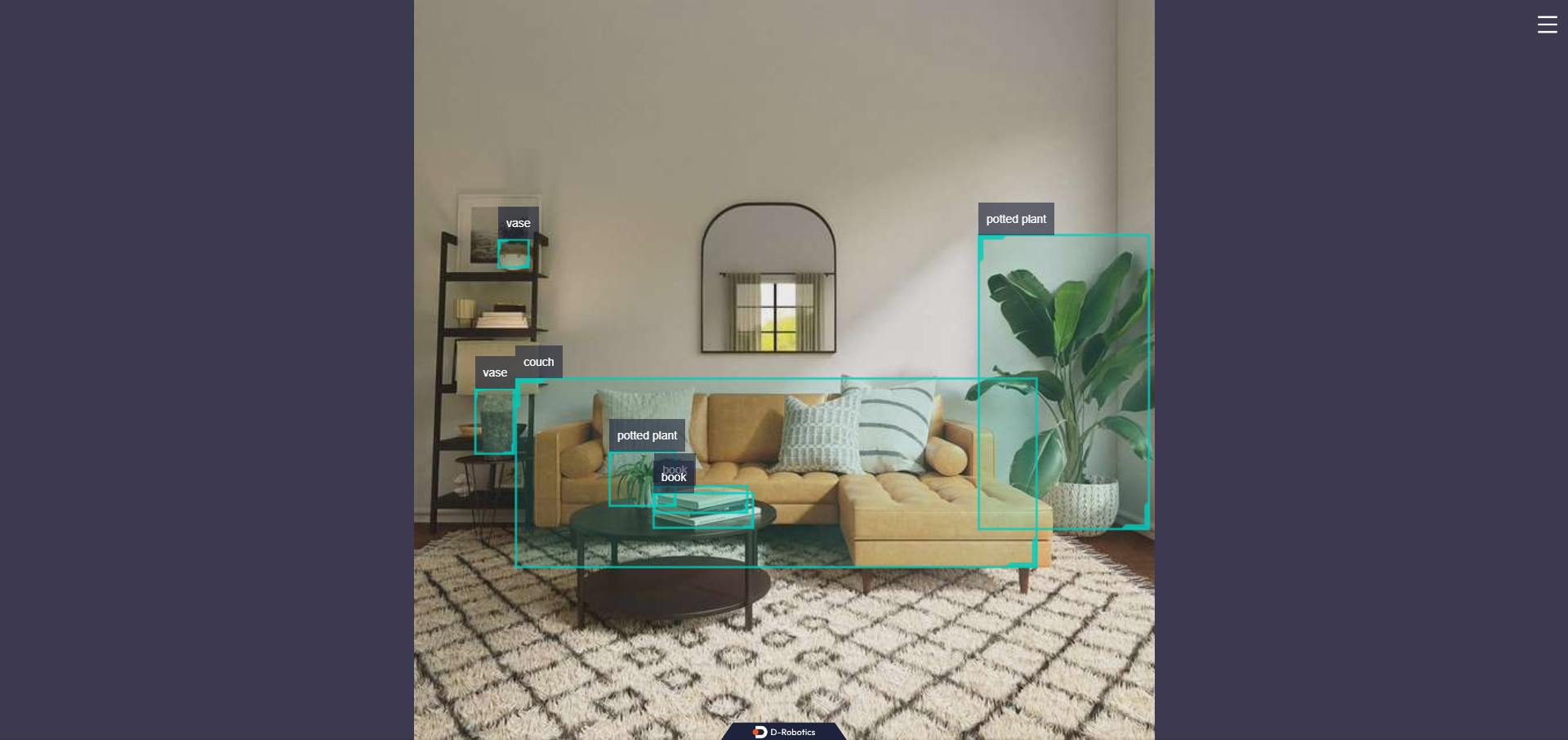
The log shows that the topic for publishing algorithm inference results is hobot_dnn_detection, and the topic for subscribing to images is /hbmem_img.
Enter http://IP:8000 in a PC browser to view the image and algorithm rendering results (IP is the RDK's IP address):
Use Local Image Feedback
The terminal outputs the following information during execution:
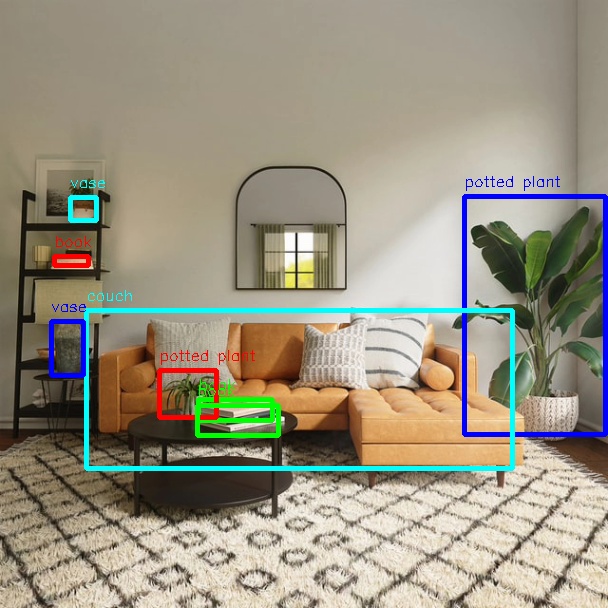
[example-1] [INFO] [1654925067.952159234] [PostProcessBase]: out box size: 8
[example-1] [INFO] [1654925067.952227232] [PostProcessBase]: det rect: 464.03 196.145 605.525 434.865, det type: potted plant, score:0.813219
[example-1] [INFO] [1654925067.952319229] [PostProcessBase]: det rect: 86.5421 310.158 512.542 468.201, det type: couch, score:0.669208
[example-1] [INFO] [1654925067.952392268] [PostProcessBase]: det rect: 198.968 399.91 273.841 421.767, det type: book, score:0.539755
[example-1] [INFO] [1654925067.952465182] [PostProcessBase]: det rect: 159.861 370.656 217.685 417.746, det type: potted plant, score:0.480698
[example-1] [INFO] [1654925067.952533221] [PostProcessBase]: det rect: 51.2147 321.047 84.0969 375.842, det type: vase, score:0.433644
[example-1] [INFO] [1654925067.952607802] [PostProcessBase]: det rect: 70.0548 197.381 96.1826 221.062, det type: vase, score:0.399885
[example-1] [INFO] [1654925067.952675924] [PostProcessBase]: det rect: 197.706 405.271 278.929 435.743, det type: book, score:0.384268
[example-1] [INFO] [1654925067.952743463] [PostProcessBase]: det rect: 54.0955 256.68 88.6269 266.159, det type: book, score:0.307426
The log shows that the algorithm detected 8 objects from the input image and output the bounding box coordinates (in the order of top-left x and y, then bottom-right x and y) and categories. The saved rendered image file is named render_feedback_0_0.jpeg. Rendered image result: